
If you work on modern enterprise IT systems, “AI Agents” are the new elephant in the room. Every day, new YouTube videos appear where someone talks enthusiastically about AI Agents and Agentic AI. The base line – software systems not using AI Agents are outdated and behind the times. But what does it really mean to integrate an AI agent into critical business applications?
Imixs-Workflow is an open-source project for building transactional, secure, and transparent business applications based on the BPMN 2.0 modeling standard. The idea is simple: you describe a business process in a model, then use a workflow engine to execute that model. The concept of a workflow engine is not new, but it remains a well-grounded approach to executing predefined business processes in a transparent, comprehensible, and transactional context. This simply means that the workflow engine guarantees a task is carried out exactly as previously defined. Execution can be performed by both IT systems and humans.
Let’s have a look how this concept is related to AI Agents.
AI-Augmented Workflows
With the rise of Large Language Models, AI brings a new level of functionality to Business Process Management. LLMs can solve problems that were nearly impossible to tackle before this new era. Their strengths lie in text understanding, classification, and extraction. Combined with the process control of a workflow engine, you can define the “what happens when and why” in a deterministic way. This is a deliberate and robust architecture for enterprise applications. At Imixs we have already published the Imixs-AI module, allowing you to integrate LLMs directly into your workflows.
In this approach, the Workflow engine still orchestrates the process. The BPMN model defines which steps are carried out in which order. The LLM is a powerful tool—but one that is called upon, not one that decides. It is integrated into the process flow through BPMN annotations.
Let me illustrate this with a real-world example: automated invoice processing.
- The system monitors a mailbox for incoming emails.
- New messages are sent to an OCR server.
- The extracted text goes to an LLM for classification: Is this an invoice, an inquiry, or an order?
- Based on the result, the engine starts the appropriate workflow.
- In the invoice workflow, the LLM creates a summary of the relevant information
- Another LLM call extracts structured data: IBAN, BIC, due date, amount
- An employee reviews and approves
- The system generates a SEPA file for bank transfer.
- The payment is confirmed.
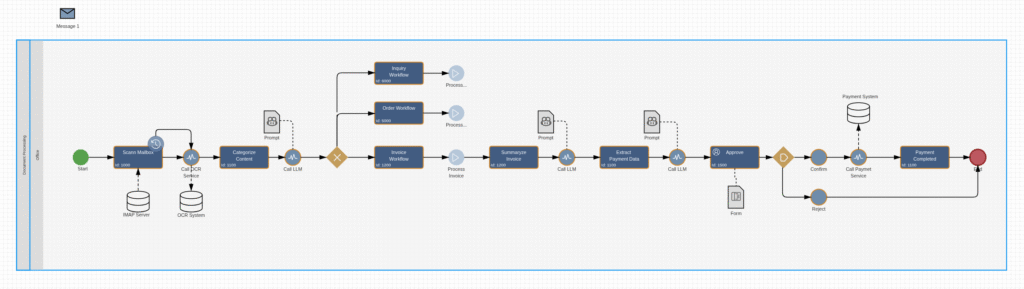
The crucial point: The control flow is deterministic. The LLM produces output for predefined steps – it does not decide what happens next.
Now let’s see what an AI Agent would do differently?
AI Agent: Your Mission, Should You Choose to Accept It…
In Mission: Impossible, the agent receives just a goal and figures out the mission itself. No instructions—just: “Make it happen.”
The AI Agent paradigm works exactly the same way. It flips the workflow concept on its head. Instead of following a predefined process, the agent is given a goal—for example, “Process this incoming email completely“—and then independently decides in a so-called “reasoning loop”:
- What is the current state?
- What tools are available to me?
- Which tool will bring me closer to the goal?
- Execute the tool, evaluate the result
- Am I done? If not, go back to step 1.
[LLM/Agent] ── decides   ▶  Which tool?   ▶   Next action?
     │                            │
     ▼                            ▼
[Understand goal]          scanDocument()
[Evaluate state]           classifyDocument()
[Choose next step]         extractPaymentData()
                           routeToWorkflow()
The fundamental difference: The process logic is no longer defined at design time, but emerges at runtime from the model’s decisions.
That sounds fascinating—and it works surprisingly well in many cases. But it is not precise. The outcome is not predictable. The decisions are no longer traceable. A 95% success rate sounds impressive. In some domains, it is. But in invoice processing, 5% errors mean:
- Incorrectly classified documents lead to compliance violations
- Incorrectly routed documents lead to payment delays
- Incorrectly extracted IBANs lead to failed transfers
These are not “oops, let’s retry” situations.
And here lies the irony: When an AI Agent doesn’t behave as expected, you start refining the prompt. “Always classify before summarizing.” “Route invoices directly to accounting.” You’re essentially defining a workflow—just through the back door, in prose. Workflows exist in enterprises for a reason. They define the compliance rules of a company.
Why AI Agents Struggle in Enterprise Contexts
The hype around AI Agents comes largely from a different context: personal assistants, research tasks, software development—domains where even a 80% success rate is acceptable because a human reviews the output anyway and errors have low costs.
The output of an AI Agent may be impressive on a first look. But it can lead into fundamental problems in production:
- Non-determinism. The same input can lead to different decision paths. How do you explain to an auditor why Invoice A was processed differently than Invoice B?
- Error cascades. If the agent makes a suboptimal tool choice in step 2, that mistake propagates through the entire chain. In a BPMN model, each step is testable in isolation.
- Debugging nightmare. “Why did the system do that?” With a BPMN process, you point to the model. With an agent, you have to trace through the reasoning token by token.
- The 5% trap. Those errors don’t distribute evenly—they cluster in edge cases, which tend to be exactly the complicated, expensive cases.
The Right Tool for the Job
To be clear: AI Agents are not inherently bad. They shine in exploratory tasks, creative work, research, and scenarios where flexibility matters more than predictability. The technology is impressive, and it will continue to evolve. But enterprise workflows often have different requirements — compliance, auditability, reproducibility. And these are not optional extras, they are the foundation of business process management at scale.
So before jumping on the AI Agent bandwagon, ask yourself: Is there a concrete use case where agentic behavior would provide a measurable advantage over AI-augmented workflows—at acceptable risk? If the answer is “not really” or “I’m not sure,” that’s not a failure of imagination. That’s engineering judgment.
Why BPMN 2.0 Remains the Sweet Spot
Another advantage of using AI-Augmented Workflows is its model based approach. A BPMN 2.0 model is not just a visualization, it is executable and it is documentation. When requirements change, you modify the model, and the change is immediately visible, traceable, reviewable. You can version your processes in Git, roll back if something breaks, compare versions side by side.
As a developer, architect, and product owner, you stay in control. You understand what the system does by looking at it. No black-box reasoning, no probabilistic surprises. In my opinion that is not a limitation. That’s exactly what enterprise software should be.
If you want to explore AI-augmented workflows in practice, check out Imixs-Workflow and the Imixs-AI module.